In the 17th century, my great grandparents sailed to New France after leaving loved ones behind in their homeland in France. Although the two did not sail together, they eventually met, married, began raising a family, and settled in Sainte-Anne-de-la-Perade.
In the 17th century, my great grandparents sailed to New France after leaving loved ones behind in their homeland in France. Although the two did not sail together, they eventually met, married, began raising a family, and settled in Sainte-Anne-de-la-Perade.
In 1643, my 9x great grandfather, Antoine Marie Leduc, was born in Louvetot, Rouen, Normandy, France. He was the son of Jean Leduc and Jeanne Franscoise Desobrie.
As a teen in 1656, Antoine traveled from Dieppe to Quebec on the ship the Saint-Sebastion. That same year he signed an agreement to serve Pierre Denys Sieur de la Ronde for one year. In 1666, the census showed that seventeen-year-old Antoine worked as domestic help for Claude Herline in Trois-Rivieres
Sometime in 1649, Jeanne was born; she was the daughter of Noel Faucheux and Jacquette Trion. In 1671, at the age of twenty-two, Jeanne Faucheaux arrived in Quebec after sailing from Saint-Pierre-es-Liens in Huisseau-sur-Mauves in Orleans, Orleanais, France. She came to the New World as a King’s Daughter; this venture sent about 800 women to New France. The women married the soldiers and frontiersman. Although no records were found, it was believed that Jeanne and Antoine married that same year. The couple had three children, Marie Francoise (1675), Jean Baptiste (1678), and Pierre Charles (1680).
Antoine worked as a fur trapper and a farmer. On May 15, 1682, he and four men, Louis Dandonneau, Paul Desmarais, Jean Morneau, and Michel Desrosiers banded together for a fur trading expedition to the Outaouais.
They proclaimed if one died during the trip, the survivors would bring back his share of furs. At Teiagon, (Baby Point, Montreal), they were attacked by the Iroquois as they headed to Michillimakinac. From that point on Antoine was not heard from again. His widow, Jeanne, remarried Pierre Vaillant on February 29, 1888. In 1689, Pierre and Jeanne had one son, Pierre Rene Vaillant.
You’re not rich until you have something that money can’t buy.
The Price of Disneyland
June of 1975 arrived warm and bright on the little island of Alameda, California. The last school bell had rung, and summer had officially begun. A cool breeze drifted in from the San Francisco Bay, carrying the salty smell of the water through our neighborhood streets and softening the heat of the sun.
Our block felt like its own small world.
Bikes rattled up and down the sidewalks from morning until dusk. Big Wheels squealed around driveway corners, their plastic wheels grinding against the concrete. Sprinklers spun lazily across front lawns, sending arcs of cool water across the grass while neighborhood kids dashed through them in shrieking bursts of laughter.
The houses on our street were a patchwork of styles and personalities. A tall Victorian with fancy trim stood proudly on one corner. Down the street was a cozy cottage tucked behind rose bushes. There were sturdy Craftsman bungalows with wide front porches where neighbors sat in lawn chairs in the evenings, and one elegant Spanish Revival house with curved stucco walls and a red tile roof that made us feel like we lived somewhere exotic instead of a quiet Navy town.
Most important, the neighborhood was full of kids. On any given day, someone always had a friend to play with.
As summer settled in, a familiar conversation drifted from porch to porch.
Vacation plans.
Some families were heading south to Disneyland. The lucky kids on the block talked about it endlessly—about Space Mountain, giant teacups, and the magical castle where fireworks exploded every night. Their excitement carried across the street as they described rides and cotton candy and meeting Mickey Mouse.
For us, Disneyland felt like another universe.
Our family was the largest crew on the block. That summer there were five of us kids, ranging in age from five to fourteen. Our house buzzed constantly with noise, laughter, squabbles, and the clatter of dishes. With a family our size, expensive vacations weren’t really part of the plan.
But our parents were good at creating adventures.
Instead of week-long trips, we explored the world in smaller pieces. We piled into the car for day trips up and down the Northern California coast. We picnicked beside rocky beaches where the wind tangled our hair and gulls cried overhead. We wandered through state parks, climbed driftwood logs, and chased waves until our pant legs were soaked.
Sometimes we even went to local amusement parks, which felt thrilling enough to us.
All of us were involved in scouting—our parents included—and scouting opened the door to even more adventures. One of my brothers, who had Type 1 diabetes, attended a special two-week summer camp each year for kids with the same condition. That camp meant the world to him.
Even though we didn’t travel far, our summers were full.
Still, that particular summer, I noticed something about Mom.
Whenever the neighborhood conversations turned to Disneyland, a quiet worry crept across her face.
One afternoon, my two youngest brothers, Keith and Danny, burst through the screen door, dusty from playing outside.
Keith looked up at Mom with wide, serious eyes.
“Mom,” he asked, “how much would it cost for our whole family to go to Disneyland?”
Mom paused. She looked at their hopeful faces and gave a small sigh.
“Well,” she said gently, “for all of us, it would probably cost around a thousand dollars.”
To us kids, a thousand dollars sounded like an impossible fortune.
Keith and Danny nodded thoughtfully.
“Okay!” they said together.
Then they ran back outside as if they had just received perfectly reasonable information.
Mom shook her head and looked at me.
“I wish we could take you kids to Disneyland,” she said softly. “It would be so much fun. I hate always having to say no.”
I walked over and wrapped my arms around her.
“You worry too much, Mom,” I said. “You’ve already given us a great life.”
She smiled, but I could tell her heart was still heavy.
Soon lunch was ready. Peanut butter sandwiches appeared on plates, along with glasses of bright red Kool-Aid. The little boys grabbed their food and headed straight for the backyard where they spread out a blanket under the shade tree for an impromptu picnic.
Mom helped them carry everything outside.
Tommy, my older brother, took his lunch to his bedroom, where wires, tools, and tiny electronic parts covered his desk. He was working on his latest invention.
Dave flopped onto the couch and turned on the television just in time for a rerun of Gilligan’s Island.
I stayed in the kitchen with Mom so we could eat together.
Even while she chatted with me, I could see that same worry lingering behind her eyes.
After the boys finished eating, they called for Mom to come help clean up their picnic. I followed her outside to gather the plates and cups.
As we picked things up, Keith suddenly looked thoughtful again.
“Mom,” he asked, “how much would it cost to have a new baby?”
Mom blinked, clearly surprised by the question.
Then she laughed.
“Oh,” she said playfully, “about the same as a trip to Disneyland.”
Keith immediately turned to Danny. The two of them exchanged excited grins, as if they had just solved a very important problem.
Keith puffed up his chest and made the announcement.
“Well,” he declared, “since they cost the same… we decided we’d rather have a new baby!”
For a moment, everyone froze.
Then the backyard exploded with laughter.
When I glanced at Mom, I saw tears shining in her eyes—but this time they weren’t tears of disappointment.
Something had lifted from her heart.
In that simple, innocent moment, she realized something she hadn’t fully seen before.
We didn’t need Disneyland.
Standing there in the backyard, surrounded by sticky Kool-Aid cups, sandwich crumbs, and the loud, joyful chaos of five children, she could see the truth plainly.
Her riches were already right in front of her.
And though she may not have realized it then, we knew it perfectly well.
Our greatest adventure was simply growing up in her love.
This grandmother also took a lover, and on the 23 Mar 1676, she had a son, Andre-Jean.
Façade of the Catholic Church Saint-Nicolas-du-Chardonnet, built in the 16th-17th centuries. Rue des Bernardins, Paris. By: Jawstrow
In the year 1643, Claude Damise was born to Etienne Damise and Genevieve Pioche. The family was located in the parish of Saint-Nicholas-du-Chardonnet in the faubourg Saint-Victor section of Paris, France.
After the death of her father, Claude decided to take her king’s offer and sail to the fledgling colonies in New France. If the colonies were to grow, they needed women for the soldiers and settlers that resided in these new lands. Between 1663-1673, King Louis XIV started a program that sent around 800 women to North America. He gave the woman a dowry and supplies to help them start their homes. In time, these women were called the King’s Daughters.
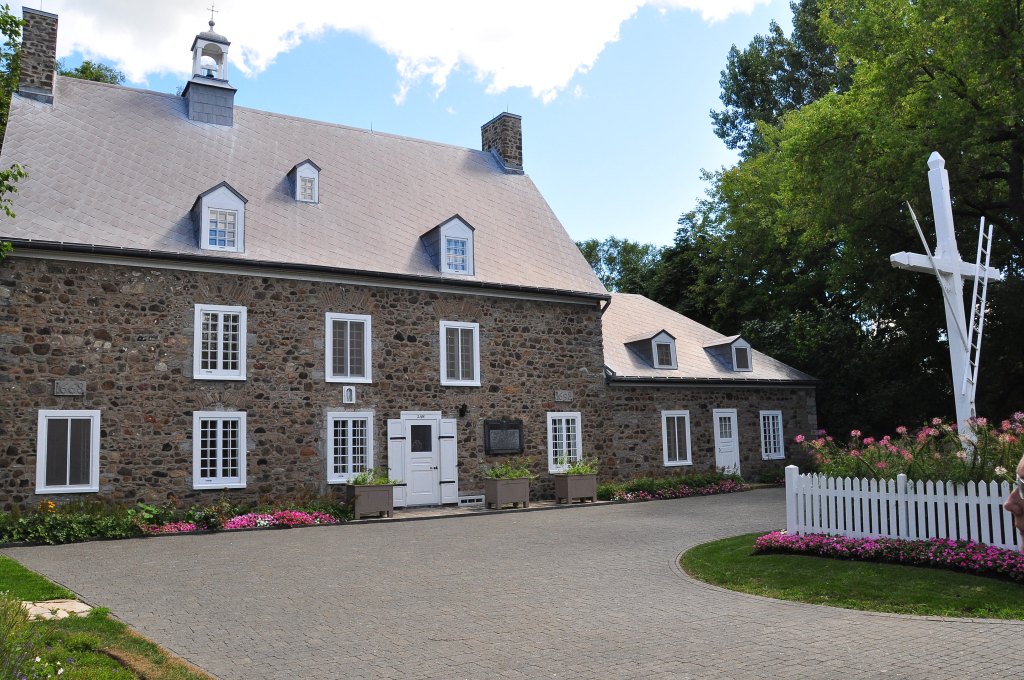
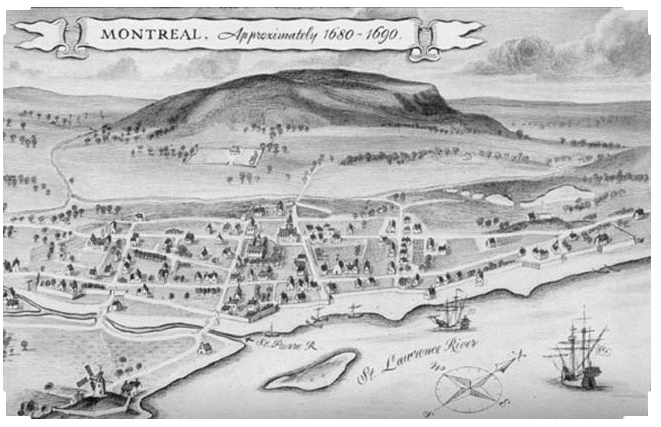
In 1668, at the age of 25 years, the young woman sailed to Canada to find a husband and a new home. When she arrived, she lodged at the Maison Saint-Gabriel in Montreal. On 10 Dec, she married Pierre Perthuis dit Lalime in Montreal. Claude could not sign the marriage contract, but her husband signed the paper. Her cousin, Francoise Guillin that was also a King’s Daughter, attended the wedding and was a witness to the ceremony.
Maison Saint-Gabriel 18 August 2012 By abdallahh
Her husband was born in 1644 in the Saint-Denis district of Amboise, Touraine, in France. Pierre’s parents were Sylvain Perthuis and Matherine Rassicot, and his father was a wood merchant. In 1665, he sailed to Canada, and he became a soldier for the Salieres Company of the Carignan Regiment. In time, he also became a merchant in Montreal, and in 1695, he enlisted as a fur trader.
Quebec Vital and Church Records (Drouin Collection), 1621-1967
The couple had twelve children, Catherine (23 Jan 1670), Jean (7 Feb 1672), Jeanne (13 Dec 1673), Elisabeth (7 Feb 1677), Marie (8 Sep 1678), Genevieve (18 Oct 1680), Marguerite-Francoise (24 Jul 1682), Angelique (1 Jan 1684), Anne-Francoise (26 Jan 1685; buried five days later), Pierre (16 Apr 1686), Francois (10 Jan 1688), and Pierre 2 (22 May 1691). In 1681, their son, Jean, died at the age of nine.
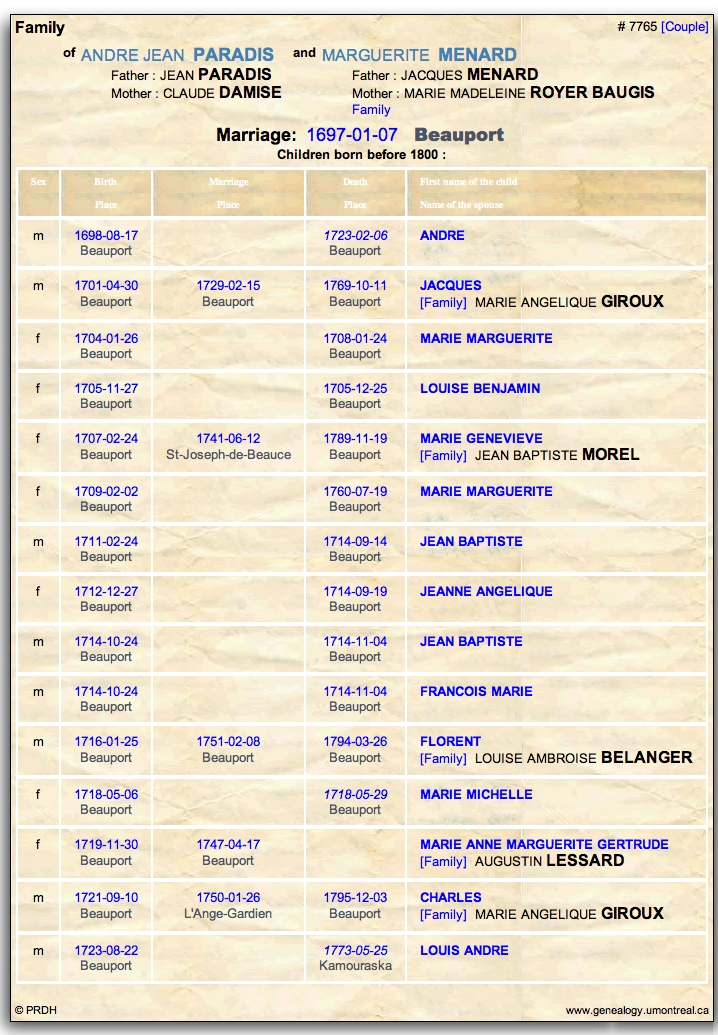
PRDH
This grandmother also took a lover, and on the 23 Mar 1676, she had a son, Andre-Jean. His father was Jean Paradis, and he was the son of Pierre Paradis and Barbe Guyon. Since Andre’s birth was well documented, I do not know if her husband was aware of her infidelity. However, records indicate that Andre was adopted by another couple, Rene Siret dit Lafleur and Anne Fayet, another King’s Daughter. This couple was childless. They did not marry until 8 Sept 1670, so Andre was adopted when he was older.
In 1682, Claude and her husband, Pierre, were involved in a scandal. A cabaret owner, Anne Lamarque dit Folleville, was taken before the courts for her immoral lifestyle. She was accused of having several lovers. In April 1682, Anne was a lodger in the home of Claude and Pierre, and they were called in as witnesses.
The cabaret, owned by Anne and her husband, Charles Testard in Montreal, was quite a popular stop among the men from all ranks of society. Since the men often traveled for their jobs, Montreal was in a central location for these men passing through the area. It also became the hub for merchants and traders, so the cabaret was an infamous hot spot for controversial behavior.
This scandalous business attained notoriety and gained the attention of the church and the civil authorities that wanted to stop the immorality in their town. As complaints began to mount against the couple, a parish priest, Jean Fremont, became involved. He wanted the cabaret closed, for the establishment was troubling; it often included violent fights as prostitutes worked their charms, and husbands cheated on their wives.
On June 17, 1862, Jean Fremont appealed to the local authorities and requested that Anne Lamarque should be stopped, and her business closed. The long trial included many of the neighbors of Anne and her husband. Interesting and sordid details even added witchcraft, for witnesses stated that Anne had a book of spells, written in Greek, Latin, and French. Some claimed she contrived spells that lured men to her place of business. Others acknowledged that the madame of this establishment created love potions that enticed the men and ensured their loyalty to frequent her place of business. Even her husband, Charles, testified that his wife was a magician. Her customers attested to her illicit behaviors and suggested that some of her children were born from these adulterous misdeeds. The couple was accused of debauchery, which also included slights against the religious members of Montreal.
Still, Anne defied the accusations, and with her influential connections in Montreal, she was acquitted, and the cabaret remained in business. Her success was short-lived; however, four years later, in 1686, the businesswoman died at the age of thirty-seven.
After this incident, no more information about Claude was mentioned, except for the fact that she continued to have children with her husband, Pierre.
In 1705, Claude died, and on the 6 Oct, services were held at the Notre Dame Basilica; she was buried in the churchyard.
Her husband, Pierre, remarried. His new wife, Francoise Moisan, was another King’s Daughter, and she was also my 10x great grandmother.
Edmund West, comp. Family Data Collection – Births, Ancestry.com Operations Ina, 2001, search.ancestry.com/search/db.aspx?dbid=5769.
Edmund West, comp. Family Data Collection – Marriages, Ancestry.com Operations Inc, 2001, search.ancestry.com/search/db.aspx?dbid=5774.
Gagné Peter J. King’s Daughters and Founding Mothers: the Filles Du Roi, 1663-1673. Quintin Publications, 2003.
Gale Research. U.S. and Canada, Passenger and Immigration Lists Index, 1500s-1900s, Ancestry.com Operations Inc, 2010, search.ancestry.com/search/db.aspx?dbid=7486.
Genealogical Research Library, Ontario, Canada. “Canadian Genealogy Index, 1600s-1900s.” Canadian Genealogy Index, 1600s-1900s, Ancestry.com Operations, Inc., 2005, search.ancestry.com/search/db.aspx?dbid=7920.
Krieghoff, Cornelius. The Habitant Farm. 1856, National Gallery of Canada, Ottawa.
Pare, Olivier. “Anne Lamarque, Dite La Folleville.” Mémoires Des Montréalais, Centre D’Histoire De Montreal, 31 July 2018, ville.montreal.qc.ca/memoiresdesmontrealais/anne-lamarque-dite-la-folleville.
Quebec, Canada, Vital and Church Records (Drouin Collection), 1621-1968.” Birth, Marriage and Death Records – Ancestry.ca, Online Publication – Provo, UT, USA: Ancestry.com Operations Inc, 2008., search.ancestry.ca/search/db.aspx?dbid=1091.
“Quebec, Genealogical Dictionary of Canadian Families (Tanguay Collection), 1608-1890.” 1920 Census | 1920 US Federal Census Records | Ancestry.com, Ancestry.com Operations Inc, 2011, search.ancestry.com/search/db.aspx?dbid=2177.
Rheault, Marcel J. Medicine in New France: Montreal Surgeons, 1642-1760, Quebec, September, 2004
Yates Publishing. “U.S. and International Marriage Records, 1560-1900.” U.S., Department of Veterans Affairs BIRLS Death File, 1850-2010, Ancestry.com Operations Inc, 2004, search.ancestry.com/search/db.aspx?dbid=7836.
“There are two lasting bequests we can give our children: One is roots, the other is wings.” Teaching children values and giving them the opportunity to excel is essential to good parenting. However, I feel I must also provide my children (and myself) insight into the ones who came before us: our ancestors whose lives and stories have shaped us into who we are. This is my journey; these are their stories…












 Tales of a Family