

In the summer of 1956, my mother stood at a bus stop in Delta, Colorado, trying not to cry.
Back then, the town was small—a quiet farming place surrounded by fields, orchards, and a wide sky that could make you feel safe and vulnerable at the same time. Dust swirled along the road. The sun felt warm on the platform. Other travelers stood nearby with their suitcases, each one thinking about where they were headed. But my mother, Dotty Allen, wasn’t focused on her destination. She was thinking about what she was leaving behind.
She had come home for a visit, back to her parents, her little sister, and the familiar routines of Western Colorado. Home meant the smell of warm earth, voices she knew by heart, her mother in the kitchen, and her father in his old cowboy shirt. It was a place where she felt understood, where love showed up in everyday things. But the visit ended too soon. Now she was going back to California, to Oakland, and to her job as a telephone operator—connecting other people’s voices while feeling the distance in her own life.
She tried to be brave. That’s what women did back then. They hid their feelings and kept going. Still, tears filled her eyes as she stood with her parents, holding onto those last moments before leaving, wishing she could make time slow down.
Then the bus came.
You could hear the bus before you saw it—a low rumble that grew louder, then the hiss of brakes and the heavy sound as it stopped at the curb. Dust rose around its wheels. The doors opened. It was time.
My grandmother, Elva, touched Dotty’s arm and pointed toward the line of passengers beginning to gather. Among them stood several young soldiers in dress greens, their uniforms pressed, their shoes polished, their faces still carrying that mixture of youth and duty.
“Oh, I would sit by that one,” she said, nodding toward a tall young soldier with dark hair and warm brown eyes.
My mother, in no mood for matchmaking and even less in the mood to be told where to sit, wrinkled her nose. “Umm… no, not that one. I think I’ll sit by that one,” she said, gesturing toward someone else entirely.
My grandfather chuckled softly. “Your mother’s right,” he told her. “I believe you ought to sit by that fella.”
This is one of those family stories we’ve told so often it’s almost become a legend—shaped by memory and retelling, but still holding its original spark. I can picture it clearly: my mother, stubborn and sad in the summer sun; my grandmother, quietly sure of herself; my grandfather, amused. All of them standing at the edge of a moment they didn’t yet understand.
Passengers started to board. Tickets were collected. Suitcases were lifted. My mother waited as long as she could, not wanting to leave just yet. She hugged her father and breathed in the clean, sun-warmed smell of his shirt. She looked at her mother, trying to remember her face. She glanced at her little sister, wanting to keep even that small, toothy grin in her memory. Then she picked up her bag and got on the bus.
The bus door closed behind her with a final sound that can break your heart a little.
Inside, she wiped her eyes and looked for a seat. Before she could lift her suitcase, one of the soldiers stood up and took it, placing it easily in the overhead rack.
“You can have the window seat,” he said.
His voice was gentle. Kind.
My mother sat down, still wiping her eyes. Once she was settled, she looked up and, to her surprise, saw she was sitting next to the very young man her mother had pointed out—the handsome one with dark hair and warm brown eyes.
Then, as if that wasn’t enough, he reached into his pocket, took out a handkerchief, and gave it to her so she could dry her tears.
Out on the platform, my grandparents saw it all. My grandfather smiled. My grandmother probably tried not to look too pleased with herself.
As the bus left, my mother turned for one last wave. Delta faded behind her, and her family grew smaller in the window until they disappeared. She sat quietly for a while, trying to pull herself together. The young soldier next to her waited patiently. He spoke softly, giving her space to talk if she wanted. After a while, she replied.
His name was Harold Reeder.
He was also going back to California, returning to his military base. Somewhere between Delta and Oakland, between sadness and small talk, between what was familiar and what was new, something started. It didn’t happen all at once or with any big moment—just a spark, a gentle shift, the quiet start of a story.
Later, the couple exchanged letters.
During the day, my mother worked at the telephone company, connecting calls, then came home to read my father’s words. My father was far away, busy with his military duties, but he still found time to write to the girl he’d met on a bus leaving Delta. With each letter, their feelings grew. Pictures exchanged with written messages, beginning with the word “Darling.” What started as a random seat choice turned into courtship, then a promise.
A year later, Harold asked her to marry him.
He couldn’t afford a diamond ring then, but love doesn’t need money to be real. Instead, he gave her something simple and unforgettable—a copper charm made from a flattened penny, shaped into an oval and stamped with the Lord’s Prayer. It looked plain, but to my mother, it was priceless. It held his proposal, his faith, his creativity, and his devotion. He gave it to her before leaving for Anchorage, Alaska, and she kept it close while she waited for him.
Four years after that summer bus ride, on May 27, 1960, my parents were married in Alameda, California.
Later, my father bought her the engagement ring he couldn’t afford before, along with a matching diamond band. She loved those rings, but the little copper charm was different. It carried the memories of those early years—the waiting, the letters, the promise, and the beginning.
Their life together was like many others—full of moves, distance, duty, sacrifice, and everyday joys. They lived in Alameda, then Fort Lewis near Seattle, then Colorado Springs and Hotchkiss, Colorado, before coming back to Alameda. Along the way, they started a family and made a home wherever they went. They always remembered that first meeting, as if our whole family grew from one bus ride and a mother’s hunch.
Of all the keepsakes in our family, two mean the most to me: the copper charm and my father’s dog tags. Time has darkened them and worn down their edges. They don’t shine like they used to, but maybe that’s how it should be. Love isn’t more valuable because it stays perfect. It’s the marks of living that give it meaning.
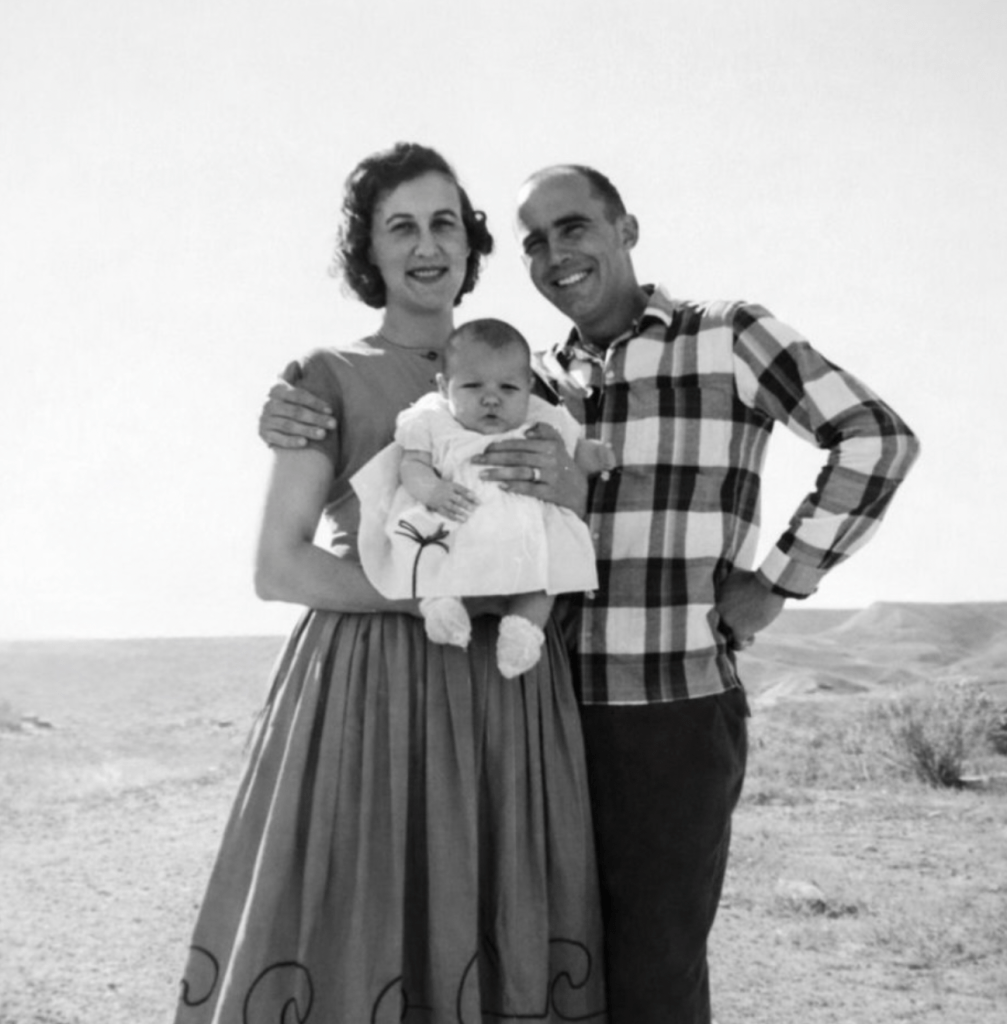
There’s a photo of my parents and me on Rogers Mesa at my grandparents’ ranch. I was just a baby. Two months after I was born, we moved to Colorado Springs when my father was sent to Fort Carson. In that picture, they’re already a family, already living the life that started with that summer meeting. When I look at it, I see more than my parents; I see the bus station, my grandmother pointing, my mother hesitating, and my father offering the window seat and a handkerchief.
And I think about how quickly a life can change.
A mother’s gentle push. A seat on a bus. A small kindness at just the right time.
And from that, everything else followed.
And I think how easily a life can turn.
A nudge from a mother. A seat on a bus. A kindness extended at just the right moment.
And from that, everything.
Dorothy Marie Allen and Harold LeRoy Reeder

 Tales of a Family