
Whispers of the Redwoods

Daily writing prompt
Do you play in your daily life? What says “playtime” to you?

The first time I entered a forest of towering redwoods, it felt like stepping into another world, where time moved slowly and the trees whispered ancient secrets. My first camping experience occurred in fourth grade with my Girl Scout troop. Our leader, Mrs. Gardner, took me and three friends—Kim Regan (Murphy), Rene Gardner, and Krissie Earl—to Big Basin in the Santa Cruz Mountains for a tent camping adventure. The first night was chilly and rainy, but the weather did not dampen my spirits. It was my first encounter with the redwoods, and I found the place magical. The fresh scent of pine and damp earth greeted us upon arrival, and the towering trees stretched endlessly toward the sky.

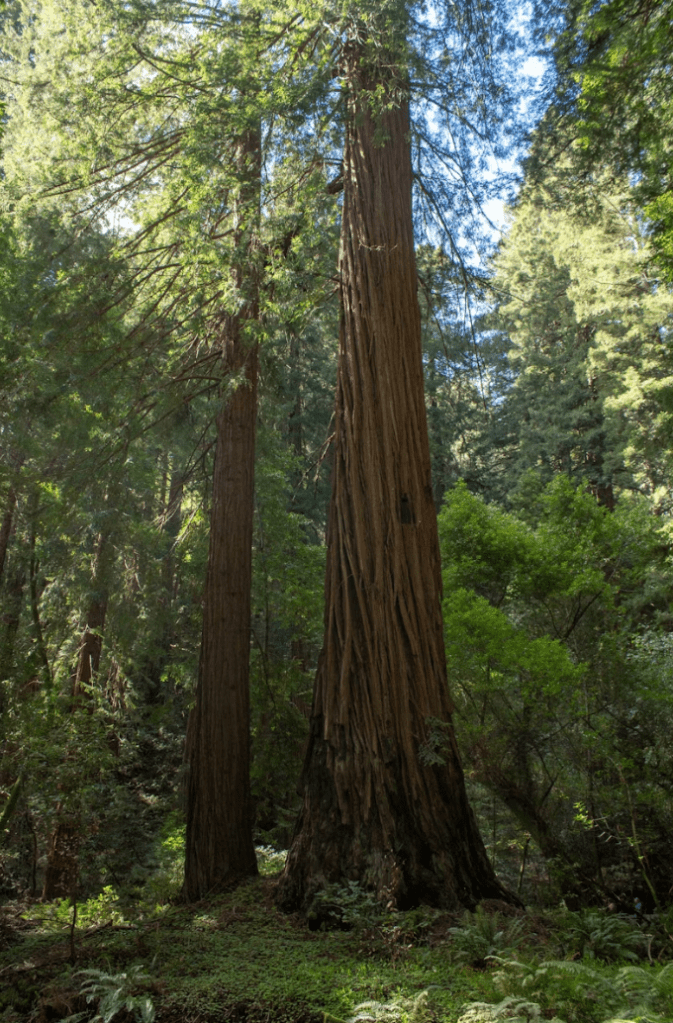
Big Basin Redwoods State Park, established in 1902, is California’s oldest state park. The ancient redwoods there are thousands of years old, some predating the pyramids. Walking among them made me feel both tiny and awed by nature’s power and patience.

I shared a tent with Kim, and we were literally washed out that first night when a small stream ran through the middle of our tent. Soaked and shivering, we sought refuge in Mrs. Gardner’s tent for the rest of the night, listening to the rain patter on the canvas and the wind rustle the massive trees outside. Despite the soggy start, the forest quickly captured my heart.

The trees were incredible. On the second day, we visited the ranger’s headquarters and nature center, where rangers taught us about the local wildlife and the trees. We learned about various plants, the foxes and raccoons that inhabited the forest, and how the redwoods had survived for thousands of years. We even saw a tree ring from a redwood that had lived before Christ was born—a humbling reminder of nature’s grandeur and the passage of time.

Once, the Grizzly Bear roamed the forest, but the ranger explained that they were wiped out during the settlers’ earlier arrival. If a bear attacked livestock or people, hunters would kill at least five bears in the area to ensure they had eliminated the attacking bear.

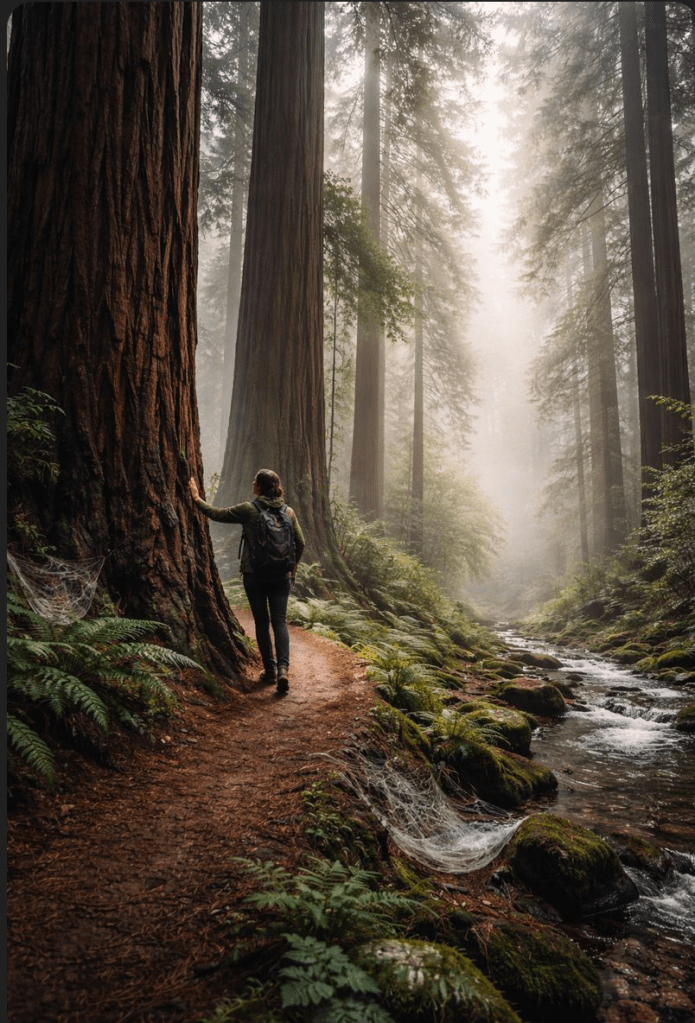
Later, we hiked the Trail of Giants, marveling at the towering trees and the quiet majesty of the forest. I ran my hands along the rough, reddish bark, looked up at branches disappearing into the clouds, and felt the soft crunch of needles under my boots. The experience left a lasting impression on me. In the morning, fog enveloped the area, dew settled on spiderwebs, and tiny streams reflected sunlight like ribbons of silver, making the forest appear magical and otherworldly. It was unlike anything I had ever seen, and I couldn’t wait to return.

Although I have visited many places since then, Big Basin is one destination I would return to repeatedly. The damp ground smelled earthy, and the air was so fresh and clean it felt like drinking pure water. The tall canopy of trees shaded the forest, allowing slivers of sunlight to peek through the branches, casting a soft, golden glow. Gentle winds rocked the trees, creating a soothing lullaby at night that helped tired campers fall asleep quickly, while the occasional owl hoot or distant rustle of wildlife reminded us we were guests in a living, breathing world.

Even now, years later, whenever I think of Big Basin, I feel a deep pull to return. It is more than a forest; it is a timeless sanctuary that leaves a mark on your heart, one towering tree, one soft breeze, and one magical morning at a time.

Moments of Joy

Often throughout our daily lives, we stumble upon small, unexpected moments that feel like treasures—instances that settle into a special place in our memories. These simple occasions, whether shared conversations, bursts of laughter, or quiet pauses in a busy day, usher in fun-filled times that linger long after they’ve passed. Over time, we come to realize that these fleeting moments, gathered almost without noticing, have become some of our favorite memories, reminders of a life well lived and richly felt.

When I moved to Colorado in 1979, I soon found employment with the Bureau of Land Management Young Adult Conservation Corps, based in Canon City. For this former city girl who loved the outdoors, it was my dream job. I was able to visit so many amazing places and witness incredible beauty and wildlife.

In the beginning, we were mainly an all-girl crew of three girls and one guy, and our work often took us to Bighorn Sheep Canyon, located between Canon City and Salida. We worked long days in all seasons. The canyon was a great place for outdoor adventures, hiking, camping, fishing, and river rafting. At Five Points, a favorite stop for fishermen, we often cleaned the area, hauled out trash, built fences, and made repairs. The surrounding area was breathtaking. Rugged mountain terrain ran along the highway to the south; a sliver of land between the river housed the area known as Five Points; and the railroad tracks ran along the canyon across the river, with mountains as a backdrop. Often, we would spot the bighorn sheep that lived in the canyon. For this former city girl, my heart always soared with excitement when one was spotted.

One winter, only the girls showed up for work. We drove to Five Points with our crew boss, Pete. I never tired of the view. On that day, the landscape was covered in white brilliance; the river formed a frozen sculpture of frozen ripples along the edges and floating, glistening ice patches that resembled large chunks of broken glass. Pete drove the truck, and I sat in the back in the crew cab with my nose pressed against the window, taking in the beauty. Pete had already gone over the instructions for the day. We were repairing a fence at Five Points, cleaning the site and the bathrooms, and hauling out the trash. Our little crew enjoyed each other’s company, and everyone talked and laughed about weekend plans.

Once we arrived, we pulled on our government-issued winter gear. Our winter pants were several sizes too large and cinched with belts, which made us look like we all had duck tails. That day, I wore a large sweater over my YACC uniform shirt and my bomber jacket over my sweater. We all wore knitted beanies to keep our ears warm. Other than the truck, no one would guess we were a YACC crew for BLM.

We quickly cleaned the area and the restrooms and began working on the fence. While we worked, travelers stopped to use the facilities, take pictures, and admire the winter wonderland. One man stopped, parked his car, and exited with a camera. He looked around and began to walk toward us. He was lean and lanky, dressed in jeans, an off-white winter coat, and expensive hiking boots. He had a warm, easy smile and a manner to match.

Pete was not with us and visited with some of the tourists who had stopped and wanted information about the area. As the young man approached, he smiled and began to talk. It was so cold that our breath was visible, like small moving clouds. Curious, he introduced himself and explained that he was a reporter from a nearby newspaper. The reporter began asking questions, and soon it became clear he thought we were inmates from the Women’s Prison.

The girls and I exchanged looks; honestly, our gear could pass for prison work gear. In a moment of complete wickedness, I decided to play along. I don’t know why I did it or where my acting skills sprang from in that single moment. But I gave an Oscar-worthy performance as the reporter began asking questions.

“Why, yes. We are from the Women’s Prison,” I sweetly answered, barely batting an eye.

“Do you mind if I ask how much you are paid for your labor?” the man kindly asked.

“Our pay? Oh, we make 50 cents a day,” I stated in a matter-of-fact voice.

His eyebrows furrowed in earnest, unnerved by my answer. In a low voice, he questioned, “Do they treat you well?”

“Yes,” I replied. “They treat us well. The work is hard, but we don’t mind because we get outside. Five days a week, and we enjoy Colorado’s beauty.”

I made quite a performance, and the rest of the crew tried not to smile.

“Our crew boss, Pete, is right over there. He keeps us in line,” I told the reporter. Pete happened to be watching us, and I waved; he responded with a smile and a quick wave of his own.

The man asked if he could take some photos, and I agreed. The three of us posed together, smiling for the camera.

As he walked away to visit with Pete, the three of us broke into laughter.

“Pete will make us pay for this one,” Kim chuckled.

Trying to look innocent, we started working once again but secretly kept glancing as the reporter approached Pete. In quick order, we watched Pete’s face change as the two men began talking, and the reporter began asking about the inmate program. We tried not to laugh as Pete’s face transformed from confusion to dawning realization to absolute disbelief.

From across the parking lot, Pete, red-faced, bellowed, “ANNIE!!” And the girls and I could no longer hold in our laughter. The reporter turned and looked at me, realizing he had been had. He threw his head back and howled with laughter, then turned and gave me the thumbs up. He and Pete spoke for a few more minutes before shaking hands. The reporter walked back to his car, his boots crunching in the snow. He smiled and gave us one last wave before climbing into his car and pulling out of the parking lot.

We turned and looked at Pete. With a stern look, Pete stormed over to us while marching like a general on a mission, ready to scold. We honestly tried not to laugh but could not hold it back.

“Annie, what were you thinking?” He angrily admonished.

Trying not to smile, I recounted, “Well, he assumed we were women prisoners, so I played along, and well, it just snowballed from there!”

Once he heard our side of the story, he couldn’t keep up his stern demeanor. The scowl on his face slowly softened, then broke entirely as he burst into a deep, unexpected laugh. In the end, he even rolled up his sleeves and helped us finish the job. For us, it was just another extraordinary day with the crew, a day full of hard work, good humor, and the kind of moments that made this team feel like family.

Looking back, that day at Five Points became one of those stories we told over and over. It was the kind of story that only comes from long hours, frozen fingers, and a bond forged by shared hard work. Life in the YACC wasn’t glamorous, and it certainly wasn’t easy, but moments like that reminded us why we loved it. We learned to laugh when the cold bit through our coats, to find joy in the absurd, and to hold tight to the friendships that made the work worthwhile. It proved that even the smallest shared moments can reveal the joy of a life shaped by connections and experiences. And even now, every time I drive past Five Points, I can still hear Pete’s voice echoing through the snow and feel the warmth of that laughter cutting through the cold.

The Garden

It had to be here. Somewhere. It had been years since she visited. Decades. But she knew this place; it was etched in her memory and in her heart. Take the first county road after passing the Victorian cottage with the bay window and the rocking chair. Her heart beat faster as she passed the little yellow house and smiled when she noticed an orange tabby curled on the rocker’s cushion. She was close now.

Her rickety blue Ford pickup turned right onto the county road. Soft clouds rolled in, and the skies darkened. She knew a summer rain would break at any moment, so she hurried up the old logging road. As the high desert plains shifted into forest, she smiled at the sight of the aspen grove to her right. She remembered that a side road would be nearby, one that ambled toward the old log cabin, inhabited by a family over a hundred years ago.

She remembered the day she and her love had explored it, surprised by the remnants left behind. Old canning jars, a wooden kitchen table in the single room with a loft above the living space. Dusty red gingham curtains hung over a window near the water pump. An old wood cookstove sat by one wall, and the coal bin still had splintered kindling, as if waiting for its occupants to return and start the evening meal. Postcards decorated one side of the wall. One, in particular, had caught her eye—a little red fox looking up at blooming wildflowers, its eyes closed in a smile.

By one window sat a sewing rocker with a small table beside it. A bowl held tiny, round wooden buttons, each one carefully carved by hand. She patted her pocket and felt the small clasp she had taken with her—the only memento of that day, so long ago.

Once she spotted the side road, she turned and traveled a short distance until the old cabin appeared in sight. She slowed, her breath catching. The years had not been kind to the cabin. It looked as sad as she felt. She pulled off the road, turning off the truck’s ignition.

“Wish you were here,” she whispered, closing her eyes. She could still see his smile from that day when he took her hand as they walked to the cabin. She remembered showing him the postcard of the fox. He had smiled, too.

“I’ll plant you a flower garden one day, in the country. That way, we can have foxes visit our yard,” he had promised.

She brushed away her tears, wishing for the time of her first love.

“If only,” she whispered softly.

Inside the cabin, her heart sank. It had been ransacked. The old cookstove was gone, along with all its furnishings. She searched for the fox postcard but found only a torn corner clinging to the wall. She ran her fingers over the frayed edge, still able to envision the picture. A bittersweet smile tugged at her lips.

She wanted to visit the creek, to see if their tree was still there—the one where they had carved their initials inside a heart. She turned to leave, but something caught her eye. A dusty piece of paper had slipped under an old crate. Turning it over, her breath caught in her throat. It was the fox postcard.

She smiled through her tears, brushing the dust off with her jeans. This time, she would rescue this treasure. She rushed to her truck, tucking it safely away, then hurried toward the creek. She needed to find their tree.

The aspens stretched out before her in every direction. It would be like finding a needle in a haystack. But she didn’t mind. The thought of seeing their tree, of finding something that tied her to him again, made her heart swell. After walking for some time, she realized she had gone too far. The skies reminded her that an afternoon rain could begin at any moment. Reluctantly, she turned back.

Though she hadn’t found the tree, she felt a sense of peace. She had found the old cabin, the postcard, and had revisited memories of a love long past. As she walked along the creek, she noticed wildflowers growing just off the path. Unable to resist, she ventured closer.

Columbine, lilies, and lupine blanketed the ground beneath the quaking aspens. She wished Jay were with her to see the vibrant garden spread out before her. She turned in a slow circle, taking in the colors, the beauty.

And then, she saw it. A darkened heart carved into the bark of one of the trees—her initials, and his.

Stunned, she sank to the ground among the flowers. His voice echoed in her mind, “I’ll plant you a garden…”

She started to cry, and the heavens wept with her, as the summer rains began to fall.

2025 February Flash Fiction Challenge: Day 1

Write a piece of flash fiction each day of February with the February Flash Fiction Challenge, led by Managing Editor Moriah Richard. Each day, receive a prompt, example story, and write your own. Today’s prompt is to write about a garden.

The Homecoming

Daily writing prompt
What makes you feel nostalgic?

Driving along the country road, my anticipation grew. Soon, I would arrive at my mountain retreat – my sanctuary in the heart of the valley. Over the years, I spent countless days here, each visit offering a respite from the demands of daily life. In the past, my family and I would take weekend trips, hiking in the nearby mountain park or leisurely exploring the town and surrounding countryside. From my first visit, I recall the magic I felt as we turned onto Pine Drive, where towering trees created a natural tunnel, sunlight filtering through their branches in shimmering rays. The homes—old and new—peeked through the pines, and I often wondered about the lives of the settlers who had once built homesteads in this valley. 


In recent years, I’ve made a point to return whenever I can steal a moment from the bustle of life. Long weekends spent here bring a deep sense of rest and rejuvenation. Despite the many beautiful spots in Colorado, it’s this quiet place that calls me back. It offers solitude and peace that I can’t find anywhere else.


Lost in these thoughts, the road suddenly dipped, and my heart lifted at the familiar sight ahead. The two-lane highway split before me: to the left, it wound upward into a forest of pines, eventually climbing into the rugged Wet Mountains; to the right, the road veered into a lush valley dotted with farmhouses and barns. We took the path on the right, and for a fleeting moment, I felt a pang of longing to follow the familiar road that led to a cabin I had once visited often—until it was sold. I had spent many peaceful days there, immersed in the stillness of the mountains, enjoying the wildlife and the antics of my Muttley Crew—Max and Mitzi. It had been the perfect escape from the frenetic pace of my everyday life.


But today, the sight of the old farmhouse with its vivid red door drew me in. Nestled in the foothills, snow still blanketed the dormant alfalfa fields, and the weathered barns stood like quiet sentinels, storing the land’s offerings. In the distance, snow-covered peaks loomed, their soft blues and creamy whites blending into the cloudy sky. For a moment, time seemed to freeze as I gazed at the farmlands below, feeling as though I had stepped into an old postcard.


As I pulled into the gravel driveway, I spotted a lone buck standing still, his antlers silhouetted against the pale sky. I quickly snapped a photo of the regal creature, who seemed unfazed by my presence. But the moment passed as soon as I released Max and Mitzi from the car. The mini dachshunds bolted into the yard, barking loudly as they chased the deer, who bounded away at the sound of their shrill voices. I called the scoundrels back, apologizing to the startled buck.


Taking a deep breath, I inhaled the familiar scent of Ponderosa Pines, their rich pine and vanilla fragrance filling the air. I walked over to one of the trees, placing my hand on its rough bark, and closed my eyes, savoring the moment. It was a scent I’d come to associate with peace and solitude, with memories of quiet days spent here in this special place.

As I surveyed the house and surrounding fields, my gaze lingered on the faded green outhouse beside the barn. I couldn’t help but chuckle at the thought that this 150-year-old home had been updated with a modern bathroom. I imagined what life must have been like on the farm a century ago. Though I grew up in the city, my mother often shared stories of her childhood on a ranch. From her tales, I knew it had been hard work, but I also knew that she cherished those days spent with her family.


It was funny how distant my city life now felt. The asphalt streets and concrete sidewalks had been replaced by dirt roads and open prairies. The hum of city traffic had been replaced by the raucous calls of quail, signaling to their young. And the acrid stench of car exhaust and burning oil had given way to the sweet, earthy scent of sagebrush and hummingbird mint. I had always known I was a country girl at heart. 


Quickly, I unloaded the car, stowing the groceries inside and setting aside the rest of my things to unpack later. For now, all I wanted was to sit on the front porch and enjoy the sunset. As the pups explored the yard, I settled into the bench on the porch, pulling my gloves from my hoodie pocket to ward off the winter chill. The crisp air swirled around me, but the gloves warmed my hands as I gazed out over the valley.

The quiet was only broken by the occasional car winding down the road, and each time, the driver would wave. It warmed my heart that small towns still held on to such customs, offering a moment of connection even to strangers. As I relaxed on the bench, the distant sound of church bells rang through the valley, their chimes a reminder of the season. Breathing in the fresh, cold air, I smiled to myself. I had returned to the mountains, to the perfect place to spend my winter holiday.