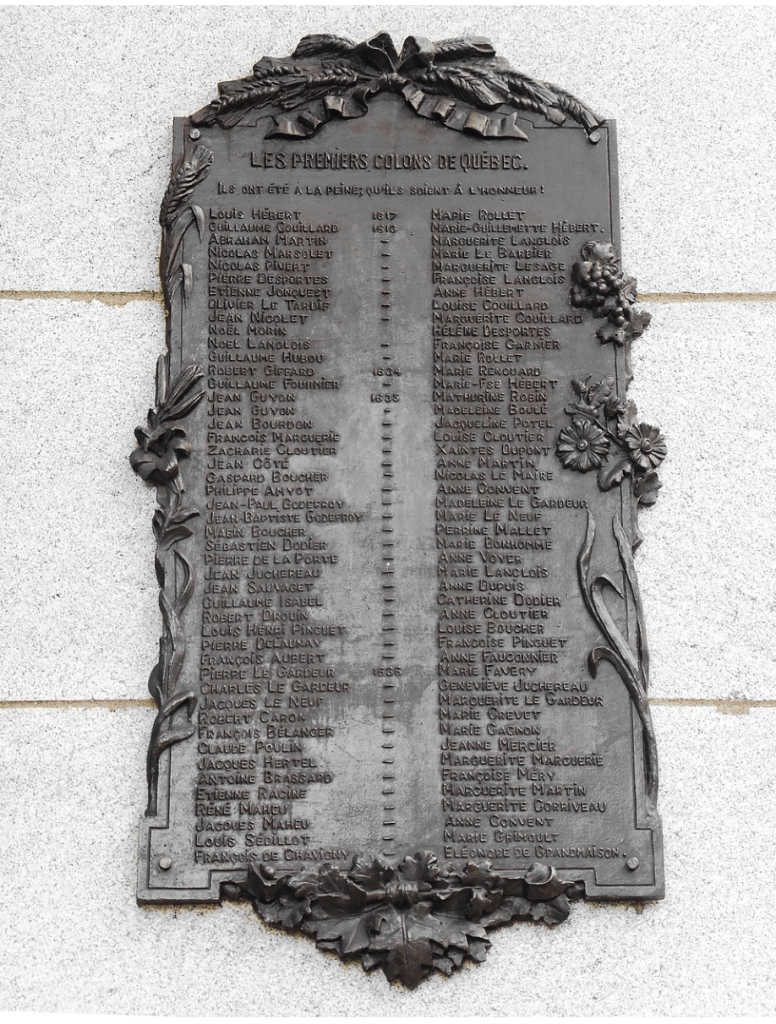
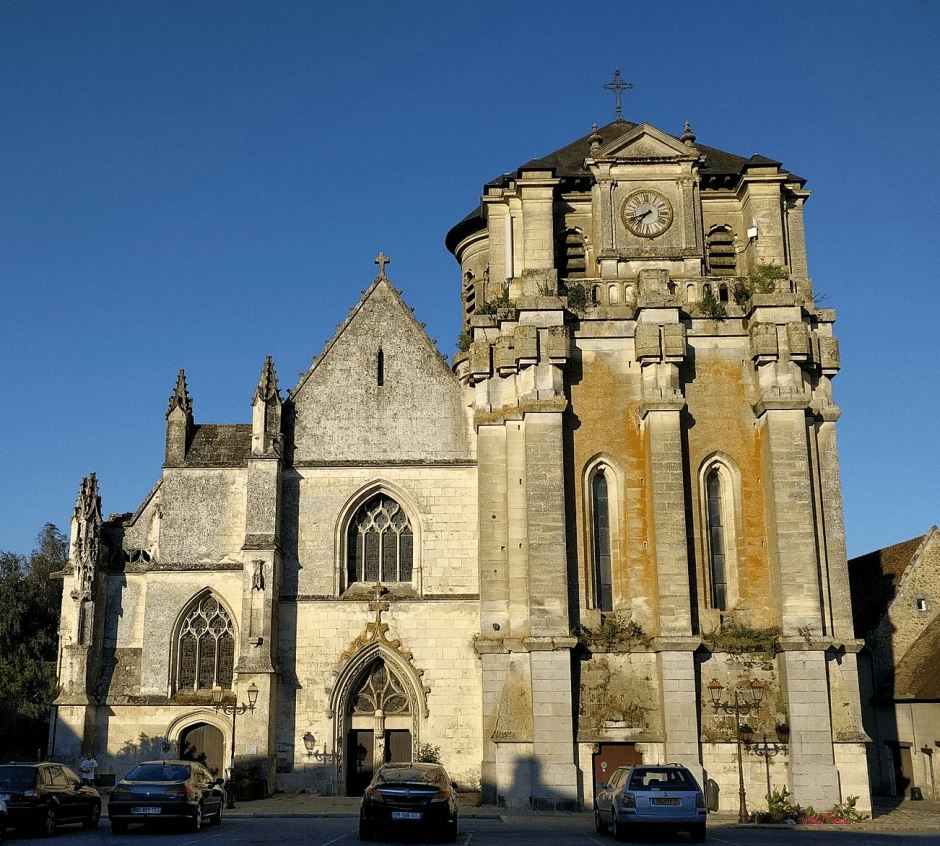
Visiting Québec is more than a journey; it is a homecoming to the roots of our family’s North American story. Our earliest ancestors helped shape New France, tending the land, building homes, and gathering in the city’s first churches. As we wander the cobblestone lanes of Old Québec, step inside Notre-Dame-des-Victoires, and stand on the Plains of Abraham, named for our ancestor Abraham Martin, we walk in their footsteps and feel the weight of their hopes and hardships. Québec City breathes history, inviting us to experience not just a place but a living legacy of faith, family, and resilience that endures through the ages.
On 18 Mar 1632, Marie Louise Cloutier was born in Mortangne-su-Perche, France to Zacharie and Sainte (Dupont) Cloutier. She was the youngest of six children.
Archives départementales de l’Orne – État Civil, Mortagne-au-Perche, Paroisse Saint-Jean et Saint-Malo, Registres Paroissiaux, 1600-1712, 3NUMECRP293/AC293_24, p. 162.
Jean Talon, Bishop François de Laval and several settlers welcome the King’s Daughters upon their arrival. Painting by Eleanor Fortescue-Brickdale.
On July 3, 1668, when she was about sixteen, Marie sailed to New France on the ship, La Nouvelle France.
As the colonies grew in New France during the seventeenth century, the men outnumbered the women. As male settlers and soldiers moved to these new lands, they wanted to settle down, marry, and have children. To help alleviate this problem, the French monarch King Louis XIV sent about 800 women to New France between 1663 and 1673. Over the years, the women became known as the king’s daughters. He provided a dowry of money and items the women would require when setting up their new homes. As soon as the couples married, they often received livestock and chickens. In addition, they were given an annual pension after the pair began having children.
When the king’s daughters arrived in the colonies, they were given room and board until they found a suitable marriage partner. A formal education was often neglected since life’s demands kept even the children busy. When children turned twelve, they took classes at Sunday school to prepare for their First Communion. In the colonies, young women were also trained to become wives and mothers. They took classes on keeping a house, and they learned to cook, preserve food, sew, mend clothes, plan, save and keep accounts. They were also taught good manners. Although life in the colonies was not an easy life, the women flourished. They tended to outlive their female contemporaries that remained in the old country.
About 1652, Marie Deshayes was born in Rouen, Normandy, to Anne Fortin and Alexandre Deshayes. On July 3, 1668, when she was about sixteen, Marie sailed to New France on the ship, La Nouvelle France. On May 20, 1668, she was confirmed at Chambly. About 1668 or 1669, she married a former soldier, Adrien Betourne dit Laviolette in Sorrel, Quebec. The couple settled in Repentigny and had two children, Pierre (about 1669) and Marie-Anne (about 1684). Two years after she arrived in Canada, her sister Marguerite came to Canada. She married Pierre Menard dit Saintonge at Sorel. They moved to Saint-Ours. The sisters lived about 50 miles away from one another.
Confirmation – 20 May 1668 – Marie des Hayes of Rouen
On August 30, 1695, a formal separation of property was ordered between Marie and Adrien. On December 18, 1707, Marie died. She was buried at the Notre Dame Ancient Cemetery in Montreal, Quebec.
18 Decembre 1707 – Marie Deshays, age 58 years, wife of Adrien Betourne dit Laviolette, died at I’Hotel-Dieu at this village after receiving the sacraments of the church. Testimony – Mr. Antoine di Valens et Henry Meriel, priests.
“Programme De Recherche En Démographie Historique. Généalogie Canadienne-Française Du Québec.” PRDH, Drouin Genealogical Institute, 2022, http://www.prdh-igd.com/.
Often, life in France offered little hope for women. Arranged marriages prevailed, and most women did not have a say in the matter of matrimony, for parental consent was required for women under the age of twenty-five. For poor families that could not offer a dowry, marriage opportunities for the women were bleak.
Thinking of home, loneliness spread through him, and he longed for his family. Time away from those he loved caused him to regret his decision. More than once, the wood runner wanted to be under his own roof, with his wife and children.
As the couple rode together, it seemed as if even the land celebrated and rejoiced with them. Autumn had arrived, and the countryside was ablaze in color.
“This land is so beautiful,” Jeanne contentedly sighed.
When the sun began to set along La Manche, Jeanne marveled at the radiant site. It was as reverent as her church, so she sent a silent request. Peace for her mother, kindheartedness for her future husband, and protection for their long journey.
“There are two lasting bequests we can give our children: One is roots, the other is wings.” Teaching children values and giving them the opportunity to excel is essential to good parenting. However, I feel I must also provide my children (and myself) insight into the ones who came before us: our ancestors whose lives and stories have shaped us into who we are. This is my journey; these are their stories…










 Tales of a Family
