Who wouldn’t love a grandfather that chased pirates, battled ship-stealing marauders, and avenged the lives of friends and neighbors?
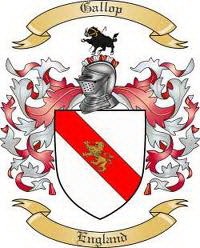
Who wouldn’t love a grandfather that loved the sea? Who wouldn’t love a grandfather that chased pirates, battled ship-stealing marauders, and avenged the lives of friends and neighbors? My 12x great grandfather was an adventurous man who sailed to a new land and cultivated a corner of this world and called it his own. On March 20, 1630, John Gallup left Plymouth, England on the John and Mary, and ten weeks later he arrived in the Massachusetts Bay Colony. After he arrived, he set his sights on the lands around the Boston Harbor, and there he made his home. Continue reading “John Gallup ~ My Seafaring Grandfather”→
The town of Cherryvale was nestled among the gentle sloping hills of southeastern Kansas. The town was aptly named for wild cherry trees bloomed every spring and an outpouring of wildflowers graced the landscape. By 1886, the railroad boom provided an atmosphere of adventure as this town began growing. The St. Louis-San Francisco Railway along with the Atchison Topeka & Santa Fe Railway had laid its tracks into this upcoming hamlet. Many businesses flourished and helped establish this developing area. Cherryvale had its own privately owned fire station. The town had six different brick factories; so many streets, sidewalks and buildings were built from sun-dried bricks. The city made use of the natural gas from the oil fields, for it was an inexpensive source of fuel. Electric streetcars ran the course of Main Street and provided access to the local businesses. Cherryvale had a bank, churches, and a school. This growing community boasted three newspapers, The Herald and the Cherryvale Torch, and the Cherryvale Republican. It even had its very own opera house. The population had grown to about 2400, and life flourished in Cherryvale.
Since I began researching my family tree, one great grandmother has eluded me. This great grandmother, Anna Strassburg, has initiated many restless nights as I have tried exploring her life. She has haunted me as I have searched record after record and web site after website. I have always wanted to learn more about her, but for a long time, it appeared that Annie just vanished. Once she left her home in Cherryvale, Kansas and arrived in Colorado, all trails ended in Gunnison. Continue reading “Finding Annie – Part One”→
The arrival of the Brides by Eleanor Fortescue-Brickdale
As she stood on the ship’s deck, the wind tugged at her hair, pulling it free from the combs and pins that tried to keep rebellious strands in place. She viewed the harbor and the lands before her. The beating of her heart quickened as she thought about the strange new life that waited for her. She could hardly imagine what secrets this new land presented; where would she live? What would her new life offer? Mostly, she wondered about her future husband, and her bewilderment consumed her.Continue reading “The King’s Daughters”→
Painting of Anne Dudley Bradstreet by LaDonna Gulley Warrick
“I am obnoxious to each carping tongue
Who says my hand a needle better fits.
A poet’s pen all scorn I should thus wrong
For such despite they cast on female wits;
If what I do prove well, it won’t advance,
They’ll say it’s stolen, or else, it was by chance.”
-Anne Bradstreet
A Woman of Faith and Words: My Grandmother, Anne Bradstreet
Throughout history, a woman’s role in American society has been a delicate balancing act, fraught with challenges. Expectations—both societal and personal—have long demanded our time, energy, and devotion. Outdated traditions and rigid norms have sought to manipulate and shame even the strongest of women, pressing them into roles defined by others. Whether managing the home, a career, or both, women have continually sought ways to uphold their responsibilities while carving out space for their own passions and creative pursuits.
So imagine my surprise—and my delight—when I discovered that one of my ancestors, Anne Bradstreet, was not only a woman of deep faith but also a quiet feminist who pursued her dreams despite the societal and religious constraints of her time. Though she lived in a strict Puritan society that carefully monitored a woman’s place in the world, Anne found the courage to write poetry—poetry that reflected her spiritual musings, her love for her family, and her reflections as a wife and mother in an unfamiliar land.
A Young Woman of Learning
Born in Northampton, England, Anne was raised in a household that, while devoutly Puritan, also valued education. Her father, Thomas Dudley, served as steward to Theophilus Clinton, the Earl of Lincoln, whose estate provided the family with both comfort and opportunity. The Earl, also a Puritan, welcomed religious leaders into his home, allowing Anne to hear sermons and theological discussions firsthand.
Unlike many women of her time, Anne was educated. Though she never received formal schooling, her father ensured she had access to the Earl’s extensive library. Under his guidance, she studied the classics, theology, history, literature, art, and music. She even became proficient in multiple languages.
During this time, she met Simon Bradstreet, a young Cambridge University graduate who came to work as her father’s assistant. By the age of sixteen, Anne and Simon were married, and soon after, Simon secured a position as steward for the Dowager Countess of Warwick. The couple moved to Warwick, but their time there was brief—political and religious tensions in England were rising, and the Puritans, increasingly at odds with the monarchy, sought a new future in the American colonies.
A New World, A New Life
In 1630, Anne, Simon, and her parents embarked on the long and treacherous journey to the Massachusetts Bay Colony aboard the Arbella, traveling under the leadership of John Winthrop. After three grueling months at sea, they arrived in Salem, Massachusetts, only to find a struggling settlement on the brink of starvation. The colonists were malnourished, supplies were scarce, and sickness spread rapidly. The constant threat of attacks from native tribes added to the tension.
For Anne, the transition was not easy. She left behind the comforts of England for the unknown wilderness of the New World. Later, in a letter to her children, she recalled her initial feelings of despair:
“After a short time, I changed my condition and was marryed, and came into this Country, where I found a new world and new manners, at which my heart rose. But after I was convinced it was the way of God, I submitted to it and joined to the church at Boston.”
Though the family settled together, their lives were far from stable. They moved frequently, trying to carve out an existence in this unforgiving land. Anne’s father and husband became deeply involved in the colony’s leadership, with both serving as governors of Massachusetts Bay. Simon, in particular, was a lawyer, judge, and lawmaker, often away from home for long stretches of time. Anne, left to care for their ever-growing family, deeply missed her husband. In an era where public expressions of romantic love were frowned upon, she boldly wrote of her devotion:
“If ever two were one, then surely we. If ever man were loved by wife, then thee.”
Poetry in a Puritan World
Over the years, Anne gave birth to eight children:
Samuel (1633)
Dorothy (1635)
Sarah (1638)
Simon (1640)
Hannah (1642)
Mercy (1645)
Dudley (1648)
John (1652)
Though she suffered from poor health—having battled smallpox as a child and later enduring partial paralysis—Anne found solace in her faith and in her writing. Many believe she began composing poetry in her teenage years, using it as a means of self-expression in a society that discouraged women from intellectual pursuits.
Her poetry reflected her deep faith, her devotion to family, and her observations of life in the Puritan world. Despite societal norms deeming such work unsuitable for women, she continued to write, sharing her verses with family and close friends. One of her dearest friends, Anne Hutchinson, was an outspoken woman who challenged religious authorities and was ultimately banished from the colony. Though Anne Bradstreet did not follow in Hutchinson’s radical footsteps, she, too, defied expectations—though more subtly, through the written word.
For most of her life, her poetry remained private. However, in 1650, without her apparent knowledge, her brother-in-law, John Woodbridge, took a collection of her poems to England and had them published under the title The Tenth Muse, Lately Sprung Up in America. With this, Anne Bradstreet became the first female poet published in both England and, later, America.
She wrote of her children, comparing them to birds in a nest:
“I had eight birds hatched in one nest, Four cocks there were, and hens the rest.”
Her words captured the complexities of motherhood, marriage, and faith. They revealed a woman unafraid to share her thoughts and emotions, despite living in a world that often sought to silence her.
A Lasting Legacy
Anne Bradstreet found peace in her faith, her poetry, and her quiet defiance of societal constraints. She was a woman who followed her heart’s calling, even when it went against the expectations of her time. She was bold, resilient, and unwavering in her pursuit of writing, even when her world sought to limit her.
As I reflect on her life, I see in her a woman much like the strong women I have known and admired—women who balance faith and family, who persevere through hardship, and who refuse to be defined by the limitations imposed upon them. Her words continue to inspire, not only as a testament to her strength but as a reminder that passion and purpose should never be ignored.
Now, I share her story with my daughter and grandchildren, passing down not just the legacy of her poetry, but the essence of who she was—a woman of faith, a mother, a thinker, and a quiet rebel in her own right.
Through Anne’s words, I have found strength. She has reminded me that, at the end of the day, it does not matter what the world believes—what matters is the courage to follow the path set before us.
And for that, I am eternally grateful.
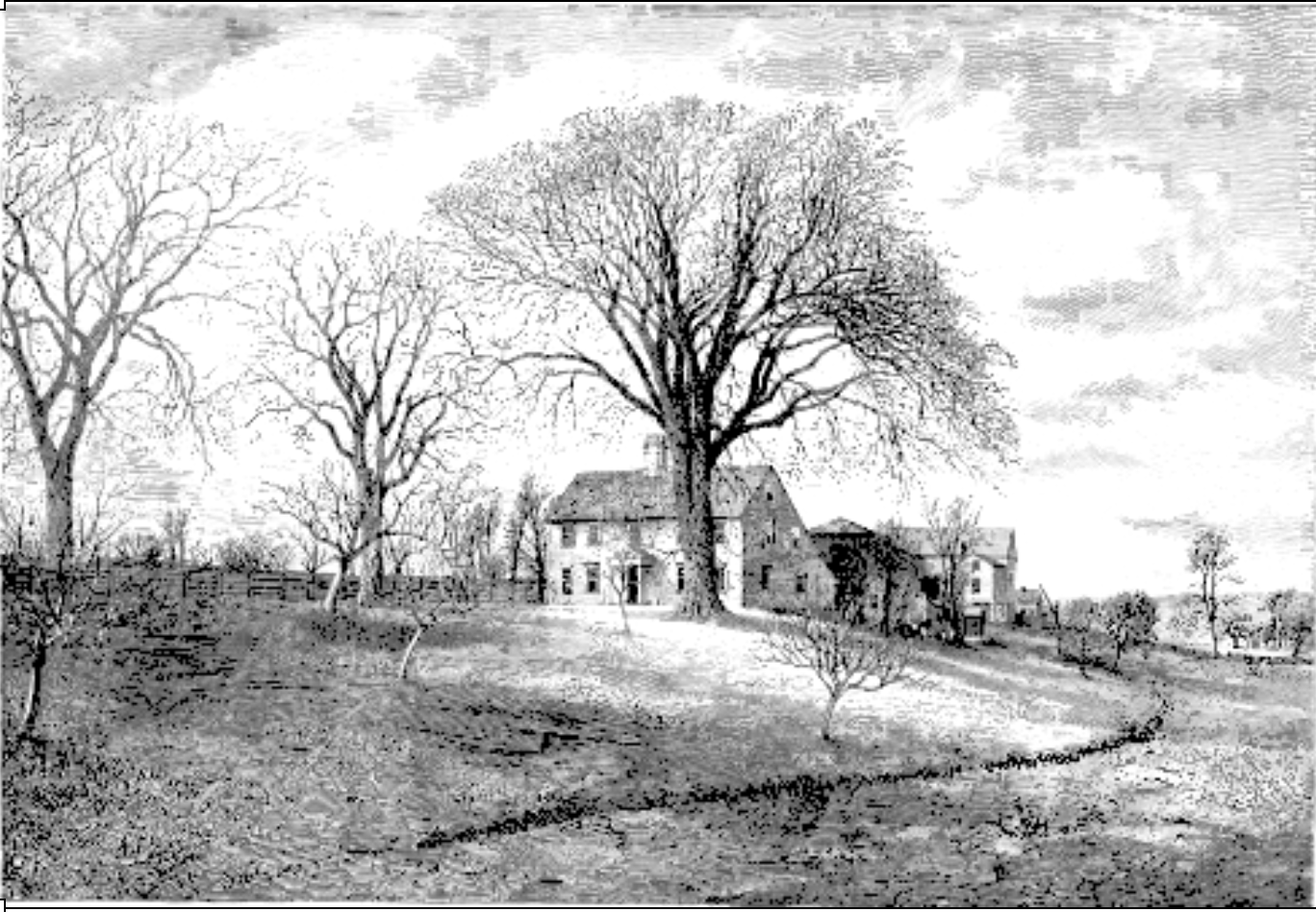
An image in The Works of Anne Bradstreet in Prose and Verse by John Harvard Ellis
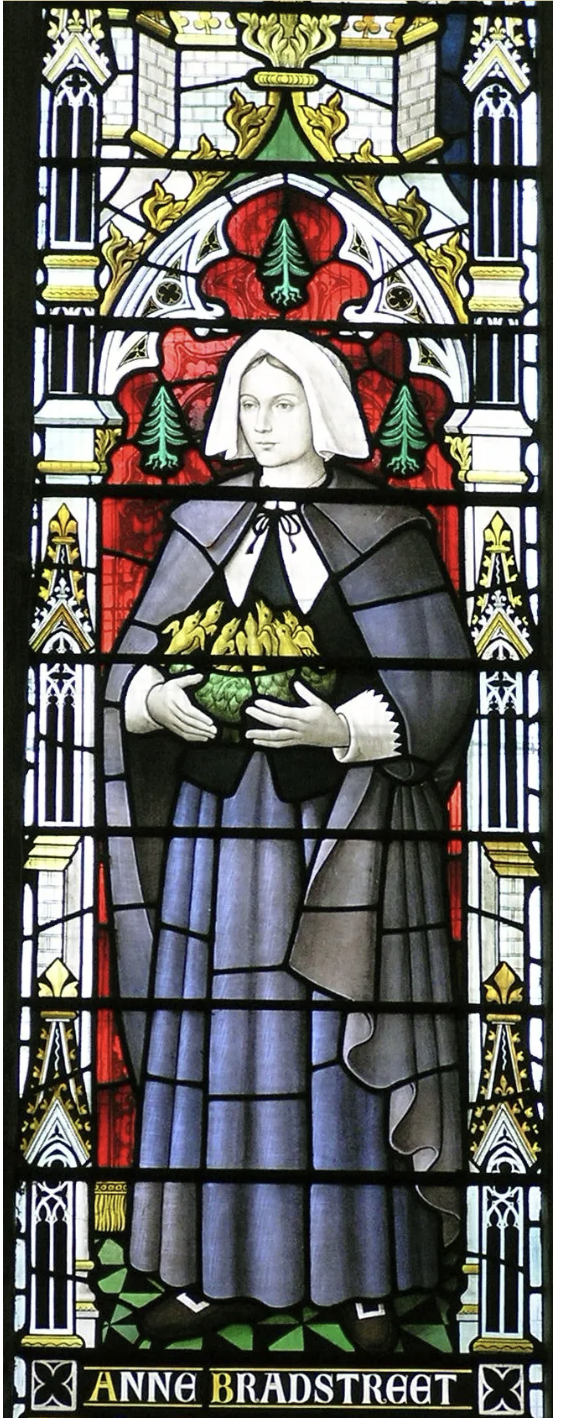
Anne Bradstreet, stained glass; St. Botolph’s Church, Boston, Lincolnshire, England
The Tenth Muse Lately Sprung Up in America (1650)
Anne Bradstreet’s notebook; discovered in a New Haven junk shop in the 1930’s.
Frey, Sylvia R., and Marian J. Morton. New world, new roles: a documentary history of women in pre-industrial America. New York: Greenwood Press, 1986. Print.
Too much time has passed since I last shared on my blog. But, I have been busy….I have just been busy researching. I have saved new family ties with added pages and saved them to the A ~ Z ~ The Family Index and the Ahnentafel Family Tree. In addition, I have found more information about ancestors and placed them on the Heroes and Patriots site. Continue reading “Research, Research, and More Research!”→
With all my misadventures this summer, I sadly discovered that I am behind on my blogging. Today, while I looked through some old papers, I found an essay that I had written in college about Emily Dickinson’s poem, “I felt a Funeral, in my Brain.” The paper was written over twenty years ago, and I would not bore you with the dissection of the poem. However, part of the assignment was to write a poem in a similar style to Dickinson’s work, and that I would love to share today. Continue reading “Emily Dickinson and Writing Poetry”→
On January 25, 1620, John Gallup was born at Bridport, Dorset, England to John Gallup I and Christobel Brushett. The infant was baptized at St. Mary’s Church (the Church of England) in Mosterne. Continue reading “Early American Settler: Captain John Gallup”→
Stephen Crane, Emily Dickinson, Ernest Hemingway, and Robert Frost just a few of the famous authors, we are related to! Yes! I can’t believe it either! No wonder, our family loves telling stories and writing….It’s in the genes! Continue reading “Oh My! We Really are Storytellers!”→
“There are two lasting bequests we can give our children: One is roots, the other is wings.” Teaching children values and giving them the opportunity to excel is essential to good parenting. However, I feel I must also provide my children (and myself) insight into the ones who came before us: our ancestors whose lives and stories have shaped us into who we are. This is my journey; these are their stories…






 Tales of a Family