The View From There

Some views become part of who we are. They may be seen from a kitchen window, a front porch, a mountain overlook, a quiet field, an ocean shoreline, a city street, or a backyard where childhood seemed to last forever. Sometimes the view itself was beautiful, and sometimes it mattered because of the people beside us.

This week, write about a view that shaped your memories. What did you see from there? Who was with you? Did the view bring comfort, adventure, peace, longing, or a sense of belonging? Describe the place as if you are standing there again, looking out over a moment that still lives in your heart.

Please share your stories and link them here.

A Place I long to Return to

Some places never really leave us. They stay tucked inside our hearts, waiting for a memory, a scent, a photograph, or a quiet moment to bring them back. It may be a childhood home, a grandparent’s porch, a mountain town, a favorite beach, a country road, or a place where life once felt simple and full of wonder.

This week, write about a place that still calls to you even after many years. What made it special? Who was there with you? What do you remember most—the sounds, the smells, the view, the feeling? Tell the story of the place you long to return to, even if you can only visit it now through memory.

Please share your stories and link them here.

The Road Home

The Road Home

Some roads stay with us long after we have traveled them. They may be country roads lined with fence posts, gravel driveways leading to a childhood home, mountain trails that carried us into quiet places, or familiar streets we could still walk in our memory. This week, write about a road, driveway, street, trail, or journey that reminds you of home. Where did it lead? Who traveled it with you? What feelings come back when you remember it?

Please share your stories and link them here.

The Road Home

Here is a blog post I wrote years ago about the road home. It is one of those pieces that still tugs at my heart, because home is more than a place. It is the people, the memories, the roads we traveled, and the stories we carry with us.

I would love for you to share links to your own stories here, too, so I can share them with my readers. Family memories make the very best stories, and sometimes, one person’s memory helps another person find their way back home.

Born on the Fourth of July

The end of June 1961 came without so much as one labor pain, and the expectant mother sighed, anxious to meet the stubborn child who refused to make her entrance.

In a small Seattle apartment, my mother sat at a kitchen table. The due date had come and gone. Glancing out the open window, she felt the morning breeze graze her face; it carried the damp, earthy scent of the Pacific Northwest, part rain, part salty sea breeze, and part conifers. Resting her hands on her growing belly, she listened as her mother and her husband carried on a lively conversation about the upcoming birth.

“The baby’s comfortable,” my father teased, glancing at the calendar on the wall. “Maybe the little one is waiting for July 8th. A good day to be born.”

My father was not shy about staking his claim; he decided the baby should be born on his birthday as if I were a pre-ordered gift he had personally ordered and was simply waiting to unwrap.

My grandma, on the other hand, was not to be outdone and decided her birthday would be the perfect day for her grandchild to make an entrance. Sitting next to my mother, she smiled, lifted an eyebrow, and declared, “Oh no. If that baby is born in July, it should be born on July 10th. Everybody knows that’s the best birthday in the family.”

And without warning, my arrival became a family feud in the making as my grandmother and my dad turned it into a lighthearted debate.

My Momma shook her head as her mother and husband laughed and continued their playful banter.

My poor mother, hot, tired, long overdue, and carrying the human prize in this birthday tug of war, pushed herself up from the kitchen table. The exhausted mother-to-be simply told the pair, “If you two are going to argue about it, I will just have my baby on the Fourth of July.” Her delivery was firm and matter-of-fact.

They laughed.

But four days later, that is exactly what she did. Her prediction would become a family legend, repeated for years as the family sat around kitchen tables. But at that moment, it was the exasperated promise of a woman who was tired of being pregnant.

On a busy afternoon, I was born on July 4, 1961, at Fort Lewis’s Madigan General Hospital, bustling with holiday babies. More than twenty babies were born that day, my mother said, as if even the maternity ward had surrendered to the patriotic spirit of the date.

“Must have been a cold October or the men were heading downrange,” one nurse muttered with a knowing smile. 

Honestly, the nurse was probably not wrong.

Outside the post would have been alive with Independence Day celebrations. Flags would have lifted in the breeze. Firecrackers would have snapped in the distance, and a marching band may have been warming up for a parade. Inside the hospital, the mood would have been quieter, with mothers cradling their babies as they celebrated the arrival of their precious cargo.

Inside the maternity ward, the army hospital still ran with military precision: polished floors, the smell of antiseptic, nurses moving briskly through the halls, and starched sheets tucked with perfectly squared corners.

My mother liked to tell the tale with a combination of pride and wonderment.

“You cost $7.50,” she liked to say.

As a child, I was offended and thought it was outrageous. “That’s all I was worth?”

She would laugh and correct me. “That was for my meals. I had to pay for my food.”

I guess I came cheap,  but lunch was extra.

Afterward came the detail that fascinated me most. “Every morning,” she lowered her voice as if she were whispering something scandalous, “I had to make my own bed.”

“In the hospital?” I asked.

“In the hospital,” she stated. “Army corners and all,” she said. “And then the women had to stand next to their beds as the head nurse came through to see if it passed inspection.”

That was one detail that remained with me as vividly as if I had witnessed it myself.  My mother, exhausted and sore after delivering her first child, was pulling stiff white sheets across a hospital bed and tucking each corner with care. The Army life did not loosen its grip for labor pains or newborn cries. Even motherhood in that world came with precise rules. Discipline lived alongside tenderness; duty held at the bedside.

I was an Army brat from the beginning, and my father’s service affected the family as a whole. I was born into that rhythm. Born on Independence Day, surrounded by uniforms and regulation corners.

At family gatherings, Dad would chuckle and say, “Well, she almost had the good sense to be born on her dad’s birthday.”

And Grandma would counter, “Or her grandmothers.”

And my Momma would simply say, “She chose her own day.”

And maybe I did claim my own day; I kept them waiting, ignored the family vote, except my mama’s, of course, and showed up when I was good and ready.

Outside, fireworks split the darkened sky with flashes of gold and red, their brilliance blooming and fading against the darkness. And somewhere between the sizzle of sparklers in little hands, I realized the Fourth of July suited this independent and stubborn gal, and I’ve been doing things on my own ever since that day.

Worn Tools, Strong Hands

You could tell a rancher’s story just by looking at his tools. The saddle, worn smooth by years of early mornings. The lariat, curled like a sleeping cat. Old pliers, a hammer with a handle that fit just right in his palm, and that pocketknife he never seemed to lose. Work gloves tossed on a fence post, a shovel resting in the dirt, a branding iron waiting by the barn wall. All of them quiet reminders that a rancher’s life was never really done.

These tools watched the sun rise and set, day after day. Each one had its own small purpose, patching a fence, searching for a stray calf, or cradling a lost lamb on the long walk back to its mother.

They remember strong hands and quiet pride, the kind that builds a life slowly…one chore, one season, one sunrise after another.

What tools do you remember from your own family stories? Maybe it was a rancher’s saddle, a grandfather’s pocketknife, a grandmother’s rolling pin, or a simple toolbox kept close at hand. I would love to hear about the tools, chores, and memories that shaped your family’s story. Share your memories in the comments and help keep these everyday pieces of history alive.

The Tools They Used

This week’s writing prompt invites us to remember the tools, objects, and everyday items that tell the story of the people who came before us. Maybe it was a hammer worn smooth from years of work, a sewing machine that stitched clothes and quilts, a recipe box filled with handwritten cards, a fishing pole, a tractor, a Bible, a camera, or a simple pocketknife carried with pride. These tools were more than objects; they were part of someone’s daily life, their work, their love, and the legacy they left behind.

Prompt: The Tools They Used
Write about a tool, object, or keepsake connected to someone you loved. What did they use it for, and what does it help you remember?

Please join in the writing and share your stories in the comments or link them here. Your memory may help preserve a piece of family history that deserves to be remembered.

A Decade of Writing, Remembering, and Growing

Katie’s Part Three: What We Learned

A Virginia Writer’s Diary

Part Three: What We Learned

My name is Katie, and I am a procrastinator.

That…was not as hard to admit as I thought.

But seriously, I am. And I do have a hard time admitting it to myself, especially now that my free time is limited and I have to be deliberate with how I structure my days. I put things off until they become a problem, and then instead of just a task, I have a problem. And then I’m stressed because I have a problem, and then I put off solving the problem until the very last minute. (This also applies to writing. And laundry. And making dinner.)

You know what makes it harder to procrastinate? Having a routine, and that’s something A Virginia Writer’s Diary has given me. I post once a week these days – I used to try for three times a week – and no matter what else is happening, I get something up on the blog.

So, there’s something I’ve learned. Give yourself a task that has to get done every week, and commit to finishing it.

But that’s a small lesson, something most people learn in a similar way. Let’s dig deeper.

I’m a perfectionist. I think it’s part of why I’m a procrastinator, honestly, because I don’t like putting my work out there until it’s perfect. But perfection doesn’t exist in this world, and I’ll make myself crazy striving for something that isn’t attainable. For years, this drive to produce perfection kept me from even getting started on writing projects. I’d write a sentence or two, decide it was irredeemably terrible slop, and stop.

It became a maddening cycle, and I desperately wanted to break out of it.

So I started writing monthly short stories. Always around a yearly theme, always posted by the end of a month. I figured any story, regardless of how not-perfect, was better than no story at all. Just choosing to write was better than not writing. This routine changed my brain. I don’t write for perfection anymore. I write because I love it, and because I hope that even if a story isn’t perfect, someone else out there will love it, too. I always hope the story I write finds its way to the person who needs it. And once I post a story, it does and doesn’t belong to me anymore. It’s my work, but the way it makes people feel, the smiles and tears, the laughs, even the boredom – those belong to the readers.

I often wish I could do things better. I wish I were a better writer, faster and more adept at dialogue and more artful with my words and more lyrical with my sentences. I wish I were a better mother, and a better person. I try to be kind, to be present, to be patient, to be loving. I succeed more times than I don’t. I do the work. In all things, I do the work. And I think that’s my biggest lesson from blogging for ten years: DO. THE. WORK.

It’s as simple and as difficult as that. Show up. Try. If you fail, try again. Keep trying. Keep working.

If I do nothing else in a day, I always do the work.

Annie’s Section: The Lessons I Have Discovered

Some journeys start from the heart with excitement, expectations, and growing anticipation of where the trail might lead. For me, this writing adventure has grown and changed, helping me discover so much about my family, my dreams, and my hopes for the future. Sometimes the most meaningful journeys begin before we fully understand where they are taking us.

Ten years ago, I began this blog with a collection of memories and a desire to keep them from disappearing. I did not have a detailed plan or an understanding of where this journey might lead. I only knew that the people, places, and moments that influenced my life deserved to be remembered.

Over the years, Tales of a Family has grown and changed, and so have I. Looking back now, I realize that writing these stories has taught me almost as much about myself as it has about my family.

One of the first lessons I discovered was that ordinary lives give rise to extraordinary stories. Stories do not need to be dramatic or perfect to matter. Some of the best events unfold on an ordinary day, just another square on the calendar when nothing exciting was planned. But then life offers us a joyful glimpse of everyday love.

Those are the precious moments spent together while sitting on porches, enjoying coffee around a kitchen table, or watching the naughty antics of grandchildren or the playful antics of dachshund pups. Those ordinary moments of life often become the anecdotes we treasure most.

Memories become clearer when we write them down. It helps me remember the details I do not want to forget, the voices, expressions, traditions, and personalities of the people I cherish, as well as the places and experiences that molded my life.

Writing prompts about songs, photographs, special places, family conversations, and familiar trinkets open the door to an entirely new story. One memory often leads to another, revealing details that have been quietly waiting to be revealed. Writing simply does not record our histories; it helps us to return to them, understand them, and see them in a whole new light.

Stories connect the generations. Every story I preserve provides my family, friends, and readers with a glimpse of the people who lived amazing lives so long ago. Each tale preserves the voices that may otherwise be lost. When sharing my stories, I help future generations grasp where they came from.  These stories become knit into the fabric of our everyday lives, bringing to mind the strength, courage, and love handed down to us as a precious gift.

Another lesson I found was that writing takes courage. While some stories are joyful, others involve grief, regret, loss, or difficult lessons. Writing honestly means that I must be vulnerable, and that was a difficult task. There are times when returning to a moment in time means returning to emotions that I thought I had stowed safely away. When we are willing to write from the heart, others recognize a piece of their own lives within our stories. And often, our most personal stories are the ones that deeply touch my readers.

Finding my voice has also been a piece of this journey. I wanted my writing to have a creative confidence and style that was all my own. Although it required practice and time, I believe my writing has become warmer, more confident, and more reflective. And while I believe I still have much to learn, I trust the ways I tell my tales. A writer’s voice develops through writing, and not waiting until it’s perfect.

I found that creativity can begin at any age. My blog has grown into more than a place to record memories. It has encouraged me to write fiction, poetry, short stories, and flash fiction. It inspired me to write short stories for a recent family book, with another in the works. It has also given me a new dream: writing a novel. There has never been an age limit on discovering a new dream or writing a new chapter.

Over time, I learned that readers want connection, not perfection. Not every sentence has to be flawless; my readers want stories that are genuine, familiar, and heartfelt. People remember how a story made them feel, and that connection is one of the greatest gifts a writer can offer.

Perhaps, most importantly, writing has helped me find my way home. Home represents my faith, my family, my friends, Colorado, the mountains, the treasured memories, and even the person I have become through all the seasons of life. Sometimes we begin writing to find our stories, but the stories help us discover ourselves.

After ten years, I understand that storytelling has become not just something I do; it has become a part of who I am. I have learned to value ordinary moments, trust my own voice, and write even when the words are imperfect.

Most of all, I learned that our stories matter. They connect us to the past, bring meaning to the present, and leave something behind for those who come after us.

I may not know where the next ten years will lead, but I know that there are memories lingering waiting to be revealed, characters waiting to come to life, and stories waiting to be told.

And I am not finished writing them.

A Quiet Hero

This week’s writing prompt invites us to remember the quiet heroes in our lives—the people who may not have asked for attention, but whose love, strength, kindness, or steady example made a lasting difference. Sometimes a hero is not the loudest person in the room, but the one who shows up, works hard, loves faithfully, and leaves behind a legacy that continues to guide us. Think about someone in your family or community whose life deserves to be remembered.

Prompt: A Quiet Hero
Write about someone in your family who may not have received much attention but made a difference.

Please share your stories in the comments and link them here. Your memory may help honor a quiet hero whose story still deserves to be told.

Finding My Way Home: A New Chapter in Family Stories

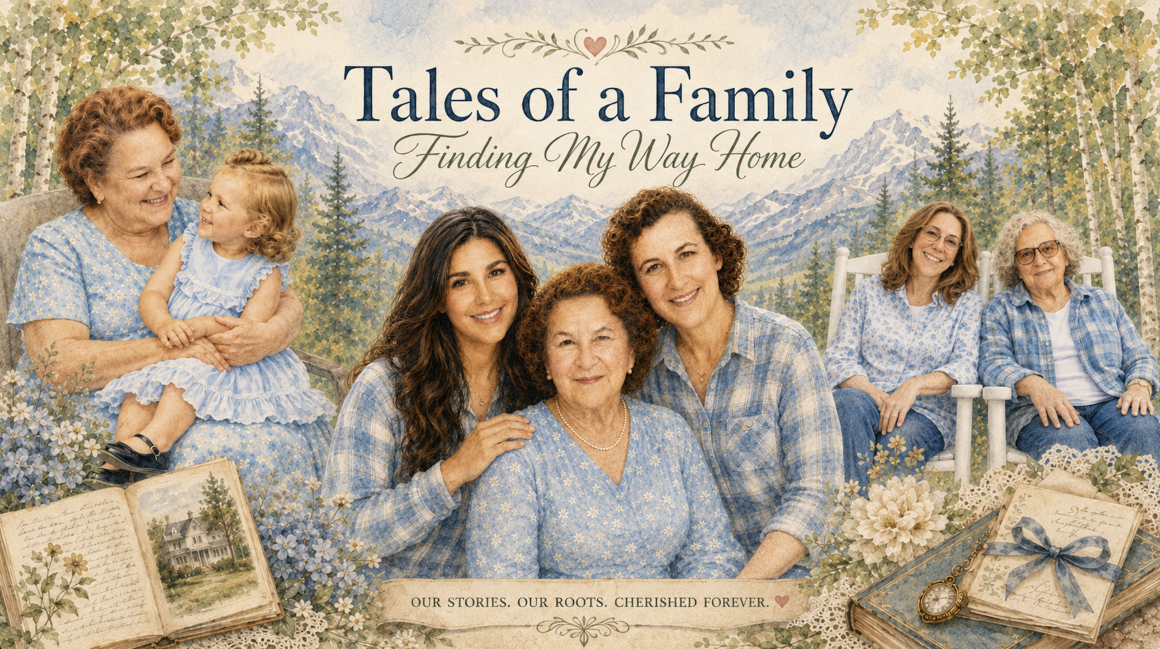
Book Two: Tales of a Family: Finding My Way Home

Book Two of Tales of a Family continues the journey through memory, family history, and the stories that shape who we are. This collection gathers more treasured moments, old photographs, family voices, and reflections from the past, weaving them together with love, humor, heartache, and gratitude. From the people who came before us to the memories we carry forward, this book is a celebration of roots, resilience, and the quiet beauty of finding our way home through story.

My goal is to have it complete by the end of the summer…